Inlays and onlays: how do they differ from crowns?
An inlay or onlay is a partial restoration made for the tooth. A crown covers the prepared tooth more widely; the choice depends on the tissues to be restored.
Important
This article provides general information and does not replace an individual consultation, diagnosis or treatment from a dentist or another healthcare professional. If you have symptoms, seek advice appropriate to your situation. Do not change a treatment based solely on this content.
These words are not enough to choose a treatment. An assessment of the tooth and its functional constraints are necessary.
You’ve heard two close terms, not knowing if they’re materials or shapes. Here, they mainly refer to the way in which the restoration fits into the tooth.
Three different levels of tooth coverage
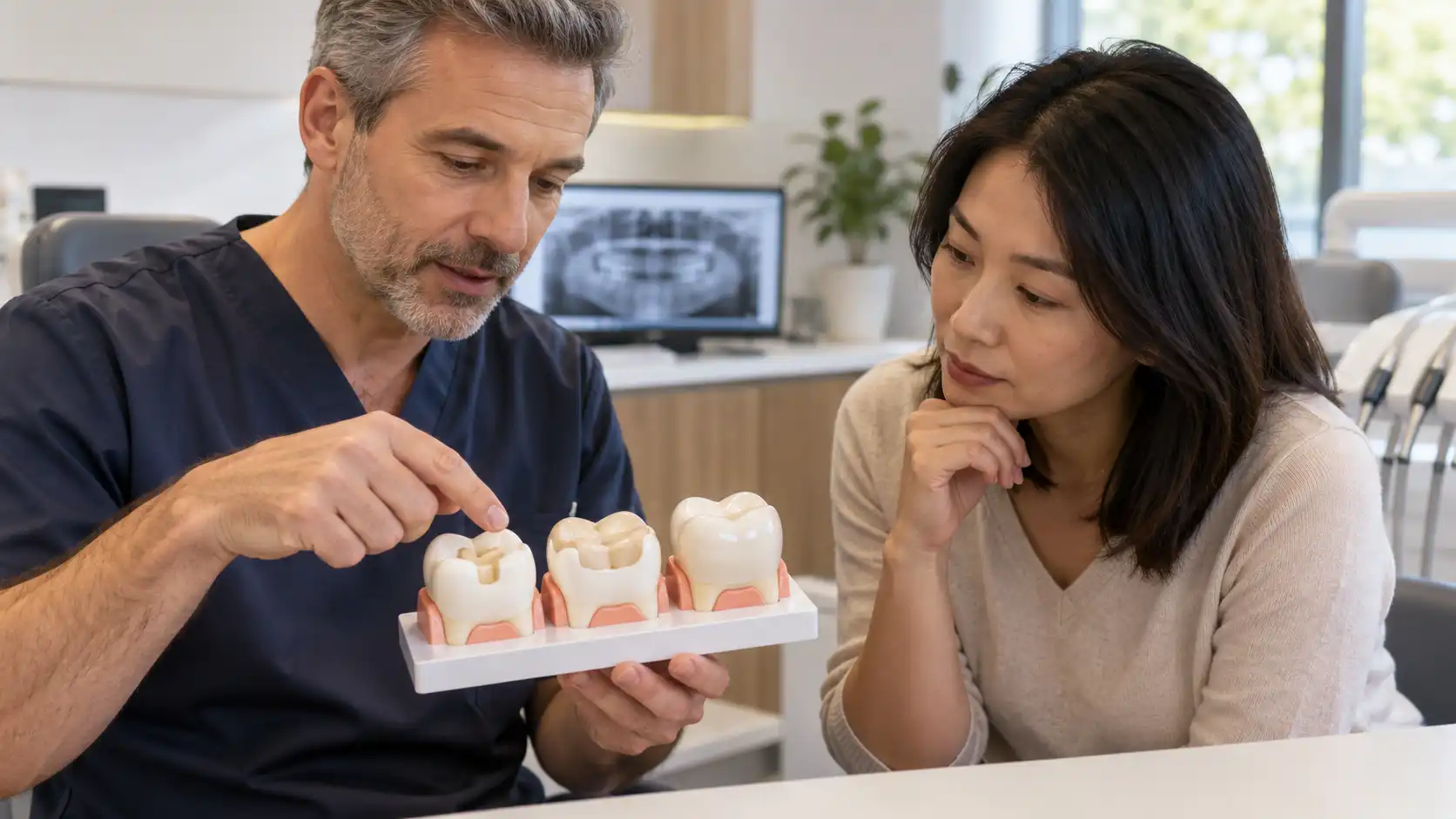
An inlay restores an area within the tooth. An onlay also covers one or more cusps—the raised parts involved in chewing. A crown covers the prepared tooth more extensively. These names describe the extent of the restoration, rather than one particular material.
These parts can be made from different materials and techniques. A restoration directly carried out in the mouth is yet another possibility. The choice is not simply derived from the name of the cavity: it is necessary to examine the quantity and solidity of the tissues that will remain.
Preserving tooth structure while supporting chewing
The practitioner looks at the remaining walls, possible cracks, contacts and fixing possibilities. A cusp cover can be useful when this relief is fragile. A more limited restoration can preserve more tissue, but it must remain compatible with the constraints of the tooth.
The position of the lesion and the necessary access to care also count. A glued part requires suitable conditions for its installation. Two teeth that have lost a similar volume can therefore receive different proposals, depending on their real state and their environment.
Treatment stages and useful questions
The course can include the treatment of decay, preparation, an impression or a scan, and then the placement of the piece. Depending on the technique, a temporary restoration or several appointments may be necessary. Ask what will protect the tooth during this time and what you can chew.
To understand the plan, show the replaced part on a drawing. Ask why an inlay, onlay or crown is retained and what would be the limits of a less extensive solution. Also check the material and financial support. After the installation, the maintenance of the edges and neighboring spaces remains necessary: no piece prevents a new decay on the remaining natural tissue.
Understanding why a partial restoration is proposed
The inlay is inserted into a part of the tooth. The onlay also covers one or more points of its chewing surface. The crown corresponds to a more extensive covering.
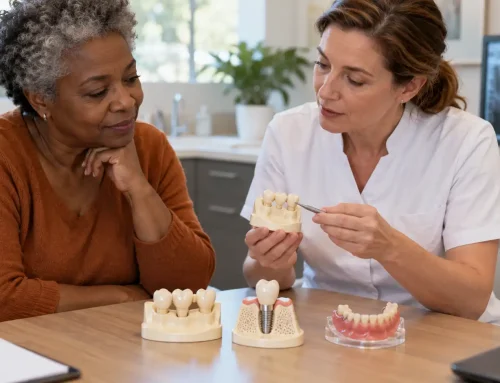
Make it clear what is left of your tooth, the limits of restoration and other possible options. An explanation on a model is often easier to follow than a series of abbreviations.
The name of the act, its material and its cost are different information. In France, the dental quote makes it possible to check what is proposed and the care to ask your supplementary health insurer.
Frequently asked questions
Key takeaways
Names describe different restorations. Ask what they cover and why the proposed option is suitable for your tooth. An inlay, an onlay and a crown restore different areas of the tooth. The choice depends on the amount of tooth structure remaining, the constraints and what the restoration needs to protect. Ask for a diagram or explanation on a model to understand the limitations of the proposed option. The material is not enough to judge the care. Have the steps, maintenance and care specified, without assuming that a restoration that covers more is systematically preferable.
Sources
Cleveland Clinic — Restorative Dentistry (2022).
Cleveland Clinic — Dental Crowns (2023).
Last editorial review: October 2026
 Numa Costa
The pen name under which I write articles and develop my editorial websites. Curious by nature, I like to understand how things work, explore everyday questions and make information easier to understand and use.
→ More about the author