Dental crowns: what are they for and what should you know?

A crown is a restoration that covers a prepared tooth. It can also be the visible part of an implant restoration.
Important
This article provides general information and does not replace an individual consultation, diagnosis or treatment from a dentist or another healthcare professional. If you have symptoms, seek advice appropriate to your situation. Do not change a treatment based solely on this content.
A crown does not make nearby tissues or a natural tooth invulnerable. The choice of care requires an assessment and proper maintenance.
The word appears on the quote, but the reason for proposing it may remain unclear. Your starting question may be, “What’s left of my tooth and what do we want to protect or restore?”
What a crown protects and restores
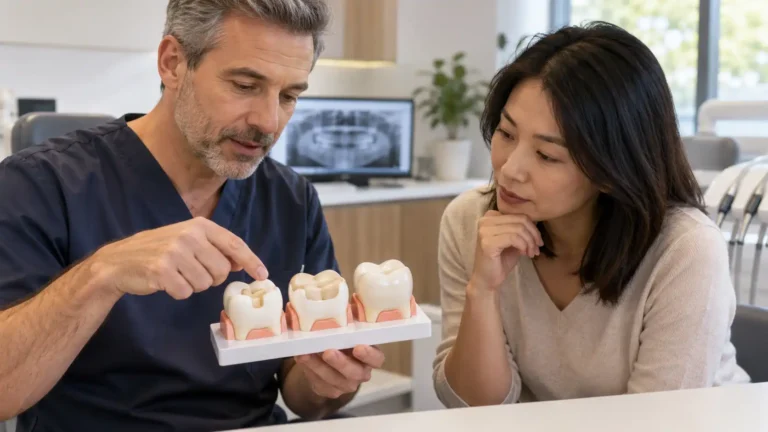
A crown covers a tooth prepared to give it shape and function. It can be proposed when the remaining structure is too weakened for another restoration. Its presence does not automatically mean that the tooth has been devitalized: these two decisions respond to different problems.
A crown on a natural tooth and a crown supported by an implant sometimes look the same from the outside, but do not have the same support. In the first case, it is necessary to continue to prevent tooth decay, especially near the limit of restoration. In both cases, the maintenance of neighboring tissues remains important.
From preparation to fitting
The practitioner assesses the amount of tissue remaining and can rebuild part of the tooth before preparing it. An impression or scan makes it possible to make the restoration. A temporary crown can protect the area during this period, depending on the organization of care.
When fitting or placement, adaptation, shape, contact with neighboring teeth and closure of the mouth are checked. Report if the crown appears to touch before the other teeth or if it interferes with chewing. The material is important, but it does not replace the quality of the fit and support.
Understanding the limits
The preparation modifies the tooth and should not be presented as a simple accessory that is removed without consequence. A crown can also crack, loosen, or require replacement. A crowned tooth remains susceptible to problems on its natural tissues.
Before accepting, ask why a more limited restoration would be insufficient, what is included in the quote and how the tooth will be tracked. After installation, specify the cleaning of the boundary and interdental spaces. Durability depends on support, chewing forces and maintenance; announcing a guaranteed number of years gives a certainty that the assessment cannot provide.
Preparing questions before a crown is placed
A severely damaged or weakened tooth may need substantial restoration. After root canal treatment, the choice depends on the individual tooth; a crown is not a rule to apply for yourself.
Ask if a more limited restoration, such as an inlay or onlay, is possible. It is not the name of the material alone that determines the best solution for you.
Specify the steps, the provisional elements and what is included. In France, the article on the dental quote and the French reimbursement categories helps you to prepare this discussion.
If a component moves or comes off, the article on a crown that has come loose explains how to contact the practice without attempting a repair yourself.
Frequently asked questions
Key takeaways
A crown meets a need for precise restoration. Understanding this need helps to discuss the choice and the quote. The crown covers a prepared tooth or is integrated into an implant restoration; its role therefore depends on what it protects and replaces. Have the status of the support, the alternatives and any provisional steps specified. The choice is not just based on the appearance or the material advertised. Ask how to clean the crown boundary and what changes should be reported after placement. Good adaptation and follow-up are still necessary, even when the result seems comfortable from the start.
Sources
Cleveland Clinic — Dental Crowns (2023).
Cleveland Clinic — Restorative Dentistry (2022).
Last editorial review: October 2026
 Numa Costa
The pen name under which I write articles and develop my editorial websites. Curious by nature, I like to understand how things work, explore everyday questions and make information easier to understand and use.
→ More about the author