Do wisdom teeth always need to be removed?
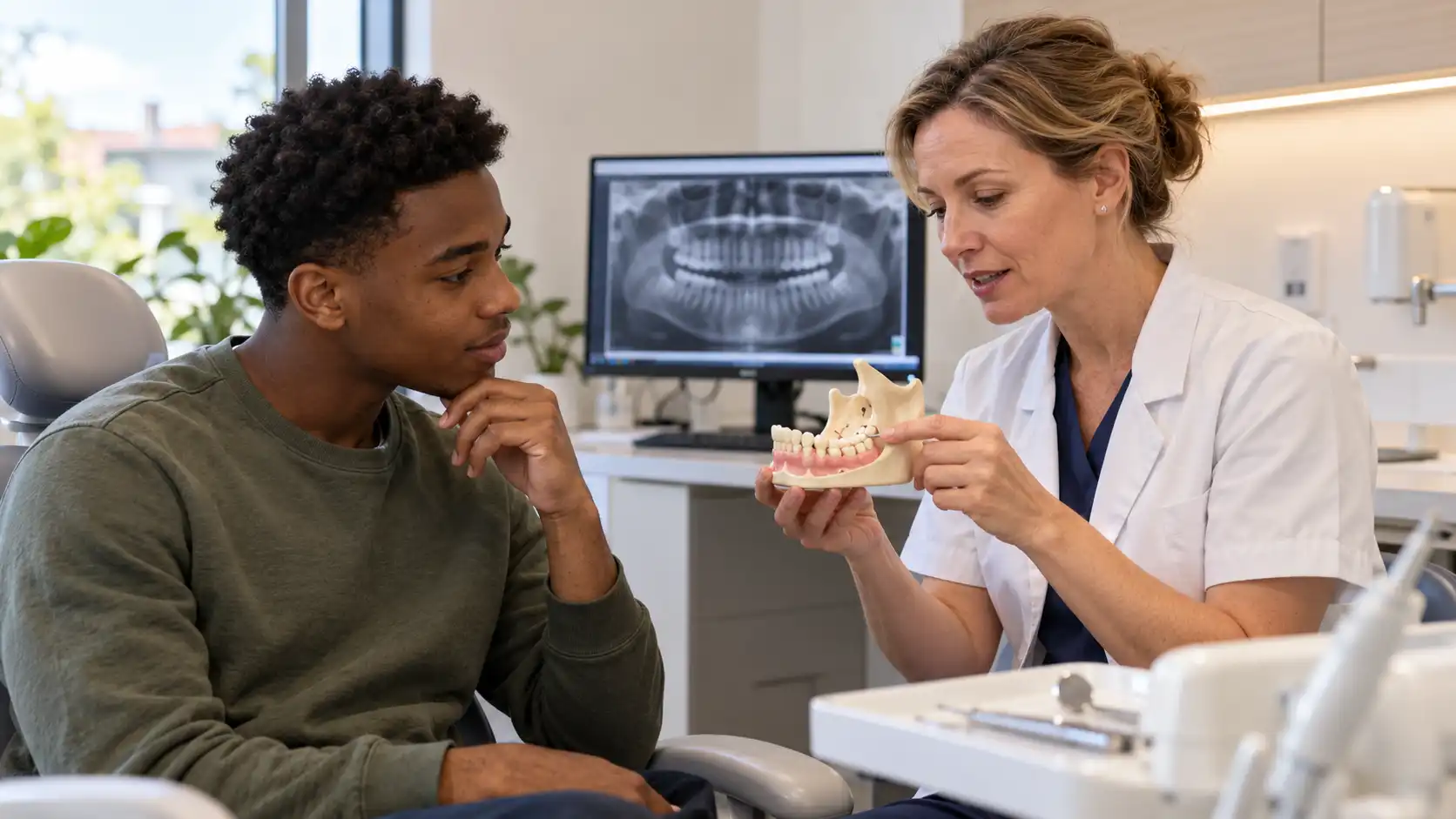
Not all wisdom teeth are removed. The decision depends in particular on the problems they cause or the risks assessed on the assessment.
Important
This article provides general information and does not replace an individual consultation, diagnosis or treatment from a dentist or another healthcare professional. If you have symptoms, seek advice appropriate to your situation. Do not change a treatment based solely on this content.
Pain, swelling or difficulty opening the mouth requires an opinion. The absence of pain does not replace the examination of a tooth already identified as problematic.
The story of a loved one does not tell what to do for your teeth. Some have had several extractions; others retain their wisdom teeth. The useful question is your situation.
Position alone does not decide whether a tooth is removed
A wisdom tooth can be fully out, partially out, or impacted in the bone. Some remain trouble-free and can be monitored. Others promote inflammatory episodes, caries, a food trap or damage to the neighboring tooth.
The assessment is looking for a precise indication. A tooth partially covered by the gum can be difficult to clean and experience repeated inflammation. A impacted tooth without symptoms does not automatically receive the same proposal. The examination and images are used to understand the consequences of his position.
Weighing monitoring against extraction
Monitoring includes appropriate check-ups and signs to report. It does not mean forgetting the tooth. The extraction also involves constraints: anesthesia, recovery, bleeding, pain and risks depending in particular on the proximity of the roots with certain structures.
For a lower tooth close to a nerve, the practitioner should explain the risk of sensitivity modification and the relevant options. For an upper tooth, the relationship with the sinus can count. These elements are individualized; an image found online does not allow to conclude on your anatomy.
Seeking advice without committing immediately
An opinion helps to understand the reason for the proposal, the expected benefits and the limits. Ask what might happen if the tooth is retained, and under what circumstances the decision would be reassessed. If several teeth are involved, explain the interest of treating them together or separately.
The date and organization should consider symptoms and complexity. Swelling, fever, or difficulty opening the mouth require quick orientation. Outside of an urgent situation, take the time to understand the course and instructions after intervention. The goal is to solve an identified problem, without making the extraction of the four teeth a mandatory step for all.
Understanding the reasons to monitor or remove
Ask what problem is identified: infection, decay, position, or a nearby tooth, for example. Make a distinction between necessary care and possible monitoring.
An intervention involves constraints and risks. The practitioner must explain what they expect from the extraction, as well as what could happen if the tooth is monitored. No choice can be deduced from a photo alone.
If an extraction is decided, the article on the preparation of the appointment helps to organize the questions. For the suites, the signs to be reported after extraction complete the instructions of the team.
Frequently asked questions
Key takeaways
The decision is based on a specific problem or risk. Ask the dentist to explain why extraction is recommended and whether monitoring is an option. The extraction of a wisdom tooth is based on a precise indication, and not just on its presence. The assessment examines the tooth, its environment and the problems or risks identified. Ask what monitoring would bring if it is possible, and the benefits as well as risks of the proposed intervention. A tooth without pain may still require an examination. If symptoms appear or change, contact the office instead of automatically waiting for the next checkup.
Sources
NHS — Wisdom tooth removal (2024).
NHS — Taking care of your teeth and gums
Last editorial review: October 2026
 Numa Costa
The pen name under which I write articles and develop my editorial websites. Curious by nature, I like to understand how things work, explore everyday questions and make information easier to understand and use.
→ More about the author