Dental implants: what exactly do they replace?
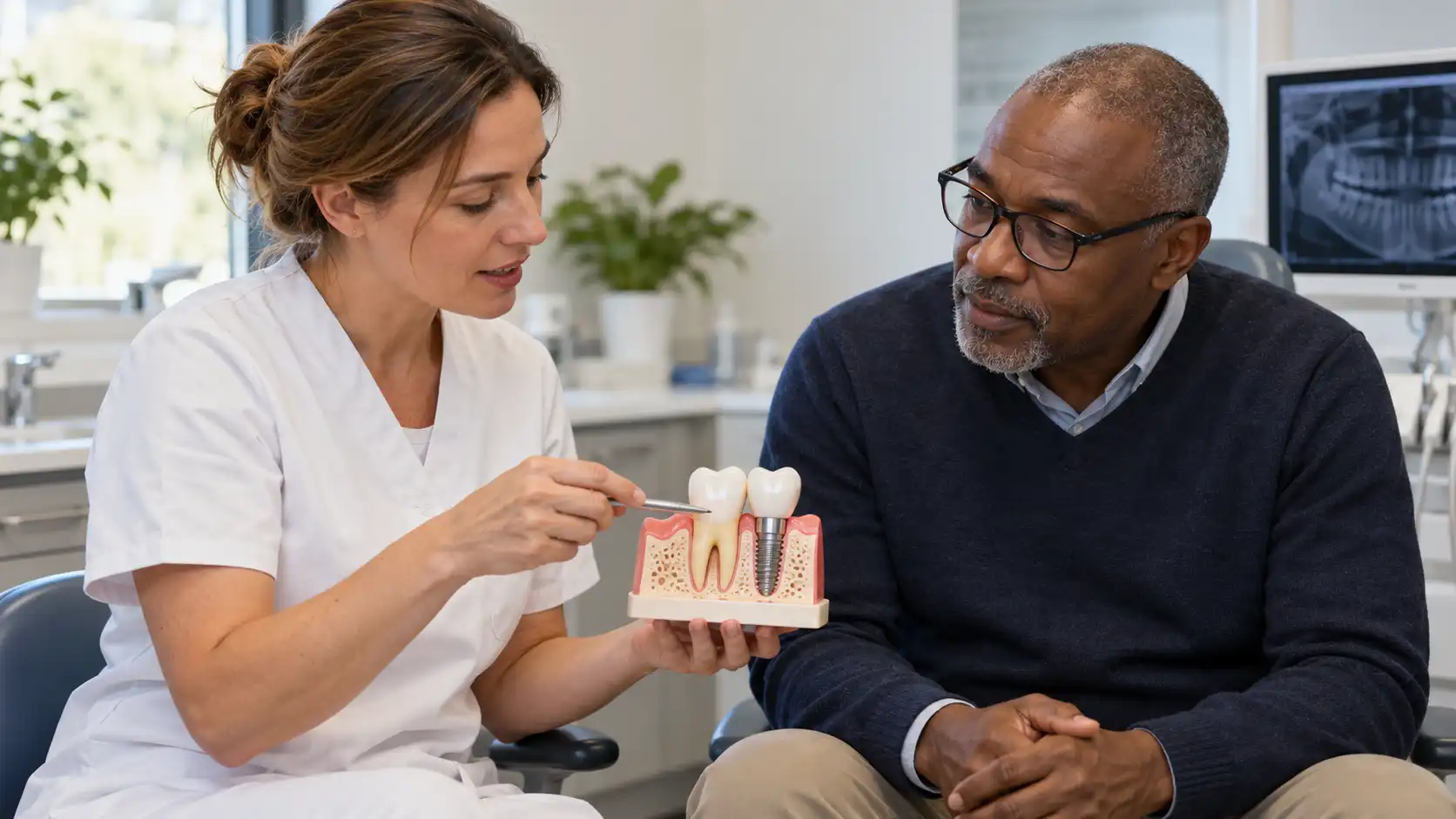
The dental implant is a device placed in the bone to support a prosthesis. The implant, the abutment and the crown designate different elements.
Important
This article provides general information and does not replace an individual consultation, diagnosis or treatment from a dentist or another healthcare professional. If you have symptoms, seek advice appropriate to your situation. Do not change a treatment based solely on this content.
An implant involves intervention, risk and maintenance. It is not suitable for all situations and does not benefit from a universal duration guarantee.
It is often said to “lay a tooth”, while several parts and several steps may be involved. This precision helps to understand both the treatment and the quote.
The artificial root and the visible tooth
An implant is a device placed in the bone to serve as a support. A abutment connects this support to a restoration, for example a crown. Depending on the assembly, screws or fastening systems are involved in the assembly. The word “implant” is often used for the whole, which can make a quote difficult to read.
These components have different functions and do not all have the same problems. A screw or crown may require intervention while the support in the bone remains stable. Conversely, an attack around the support does not resolve simply by redoing the visible part.
Different ways to replace a missing tooth
An implant can wear a crown for an absent tooth. Several implants can also support a bridge or help stabilize a removable prosthesis. The number of teeth replaced is not always equal to the number of implants.
The choice depends on the bone available, the tissues, the neighboring teeth and how to chew. It must also take into account the possible maintenance and overall cost. A bridge supported by teeth or a removable prosthesis can be other options; their constraints must be explained in the same way.
What to understand before agreeing
The treatment plan includes a surgical phase and a prosthesis phase. Healing allows the bone to establish a stable relationship with the implant; its course varies according to the site and the situation. A provisional solution may be needed during this journey.
Ask for a diagram showing what will be placed, what will remain visible and how the cleaning will be done. Have the steps included in the quote, any prior care and subsequent visits specified. Keep the references of the installed device. An implant avoids decay on its artificial part, but not inflammation of the surrounding tissues: monitoring and maintenance are necessary after the final tooth is placed.
Understanding the implant within the replacement plan
The implant body is anchored in the bone. A connecting component supports the visible restoration. What looks like a tooth in your smile is therefore not the implant alone.
The assessment before implant placement examines your situation and needs. The goal may be to replace one tooth or support a larger restoration; the number of missing teeth alone does not describe the treatment plan.
The comparison between bridge, implant and removable prosthesis helps to prepare the discussion. Ask why a solution is proposed, what it asks for on a daily basis and the limits of other options.
Understanding the placement and healing stages also explains why treatment involves more than the procedure itself.
Frequently asked questions
Key takeaways
Understanding the components makes the treatment plan more readable. An implant proposal is discussed with its alternatives and maintenance. The implant replaces a root; the abutment and crown complete the visible reconstruction. Distinguishing these elements helps to understand the quote, the steps and the future maintenance. Before deciding, have the indication, alternatives and necessary conditions specified in your mouth. The treatment plan is not limited to the installation of a screw: healing and restoration have their own calendar. Keep the device references and ask for the monitoring program, without waiting for a guarantee of duration valid for all.
Sources
FDA — Dental Implants What You Should Know (date non affichée).
Leeds Teaching Hospitals NHS Trust — Dental Implants (2025).
Last editorial review: October 2026
 Numa Costa
The pen name under which I write articles and develop my editorial websites. Curious by nature, I like to understand how things work, explore everyday questions and make information easier to understand and use.
→ More about the author