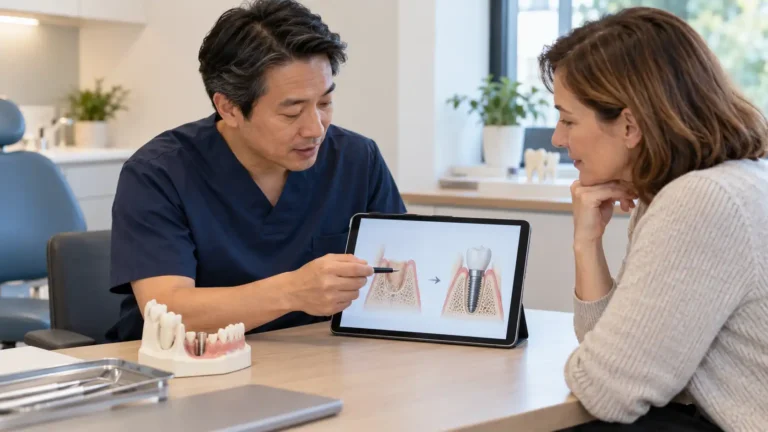
Dental implants: why does treatment involve several stages?

Implant treatment involves preparation, installation of the device, a period of healing and the realization of the prosthesis. Organization and timelines vary.
Important
This article provides general information and does not replace an individual consultation, diagnosis or treatment from a dentist or another healthcare professional. If you have symptoms, seek advice appropriate to your situation. Do not change a treatment based solely on this content.
An announced schedule remains dependent on the assessment and healing. Increasing pain, unusual swelling or mobility should be reported to the team.
When several months are mentioned, the question quickly becomes: “Will I stay toothless all this time?” It deserves a personalized answer rather than a promise found on an advertisement.
Gum healing and stabilisation in bone
The gums may appear closed as the stabilization process in the bone continues. The disappearance of an external discomfort does not automatically mean that the implant is ready to receive all the chewing forces.
After installation, the schedule takes into account the initial stability, bone, possible grafting and prosthetic project. Immediate loading can be offered in selected indications. It does not mean that all patients can complete a full implant treatment on the day of the procedure.
From assessment to final restoration
Treatment may include preliminary care, an extraction, implant placement and a healing period. Some arrangements leave a healing component visible; others require a later step to access the implant. Impressions or scans are then used to make the restoration.
A temporary prosthesis can maintain aesthetics or help prepare tissues in certain situations. Its constraints must be known: what you can chew, how to clean it and what to do if it becomes mobile. The final restoration is controlled for its adaptation, contacts and access to cleaning.
A useful schedule includes decision points
Rather than a single end date, ask for a list of steps with the conditions to move on to the next. For example: check the healing before taking impressions, check the prosthesis before fixing, then follow up after use.
If a step is delayed, it is necessary to know the reason: difficulty in healing, need for adaptation or organization of the laboratory. An additional delay is not automatically a failure, but it must be explained. Report growing pain, unusual swelling or mobility without waiting for the next scheduled date. Finally, keep in mind that delivery of the crown completes the manufacturing phase, while maintenance and check-ups continue thereafter.
Planning the stages towards the final tooth
The implant body and prosthesis are not always put in place at the same time. The healing of the bone is involved in the stability of the treatment plan. Ask what steps apply to your case.
Make clear the possibilities of provisional solution and their limits. Also ask about the constraints related to meals, work and check-ups. A written plan reduces misunderstandings.
The duration cannot be deducted from the number of appointments. The conditions of healing or prior care may change the following. The initial assessment explains some of these differences.
Frequently asked questions
Key takeaways
Understanding what happens between appointments helps to organize treatment. The schedule must remain adapted to your situation. The placement, healing, possible provisional phase and final restoration correspond to distinct needs. The time required depends on the treatment plan and the evolution of the tissues; an announced schedule remains to be confirmed over the course of the checks. Make it clear what you can use between steps, restrictions, and signs to report. A temporary tooth does not mean that all phases are complete. The follow-up is used to decide when to progress, with suitable maintenance from the beginning.
Sources
FDA — Dental Implants What You Should Know (date non affichée).
Leeds Teaching Hospitals NHS Trust — Dental Implants (2025).
Last editorial review: October 2026
 Numa Costa
The pen name under which I write articles and develop my editorial websites. Curious by nature, I like to understand how things work, explore everyday questions and make information easier to understand and use.
→ More about the author