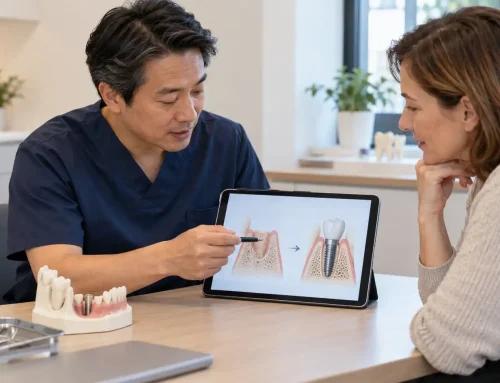
Bone graft materials: what should you ask about their origins?

The materials of a bone graft can come from the patient, a donor, an animal origin or be synthetic. Their choice depends on the treatment plan and medical considerations.
Important
This article provides general information and does not replace an individual consultation, diagnosis or treatment from a dentist or another healthcare professional. If you have symptoms, seek advice appropriate to your situation. Do not change a treatment based solely on this content.
The origin of a material is not enough to predict its outcome. Ask for the name, traceability, limits and risks of the product actually proposed.
For some people, the origin of the material is simple information. For others, it involves personal convictions. This question has its place in the consultation, without having to justify it.
Four material groups with different considerations
Autogenous material comes from your own body. It involves a donor site, with its constraints. An allogeneic material is of human origin; a xenogenic material comes from another species. An alloplastic material is synthetic. These terms indicate origin and do not constitute a quality classification.
The products are prepared and used according to precise indications. They can be associated with each other or with a membrane. The name of the family does not necessarily describe all the assembly that is proposed to you. Ask for the actual product and the place it occupies in the intervention.
The choice also depends on the intended function
Depending on the bone defect, the practitioner may seek to maintain volume, rebuild an area, or allow subsequent placement. The amount needed, the site and the technique influence the choice. Two patients with missing teeth do not necessarily have the same need for reconstruction.
Avoid conclusions based on a single word: “natural”, “organic” or “synthetic” does not mean no risk or superior result. The practitioner must explain the expected benefits, limitations, other options and, if applicable, the consequences of an additional sample.
Discussing preferences and keeping records
Personal convictions, reluctance to take samples or a desire to understand an animal origin are legitimate subjects. It is better to express them during the preparation, before the device is ordered or the intervention organized. A preference can be compatible with an alternative; it can also modify the treatment plan and its limits.
Ask for written information to find the name and origin of the material. Also note the role of a possible membrane. These elements facilitate your understanding and future consultations. Choosing remains a clinical discussion: a product listing is not enough to know if it suits the shape of your bone site.
Asking about the material’s origin and role
A general label does not necessarily describe all the components planned. Ask about the main material and any other elements involved in the bone grafting procedure.
Ask what the practitioner expects from this material in your situation. The answer should be your intervention, not just a commercial presentation or product reputation.
If you have concerns about a particular origin, raise them before consenting. The dentist can explain possible alternatives and their requirements. This discussion belongs within the treatment assessment.
Frequently asked questions
Key takeaways
A question about origin is legitimate. The decision must include your preferences and a clinical explanation of the proposed material. The materials may have different origins and play different roles in the reconstruction project. Before consenting, ask for their name, their provenance, their function and the place of a possible membrane. You can also discuss your personal preferences and available alternatives. A difference of origin does not allow to classify alone the materials from the best to the least good. Relevance depends on indication, local conditions and technique, with clear information about benefits and limitations.
Sources
Cleveland Clinic — Dental Bone Graft (2024).
Cambridge University Hospitals NHS — Bone grafting for dental implants (date non relevée).
Last editorial review: October 2026
 Numa Costa
The pen name under which I write articles and develop my editorial websites. Curious by nature, I like to understand how things work, explore everyday questions and make information easier to understand and use.
→ More about the author