Before a dental implant: what does the assessment check?

The assessment before an implant checks whether the treatment plan is suitable for your health, your mouth and follow-up conditions. A photograph or a price is not enough to decide.
Important
This article provides general information and does not replace an individual consultation, diagnosis or treatment from a dentist or another healthcare professional. If you have symptoms, seek advice appropriate to your situation. Do not change a treatment based solely on this content.
Inform the practitioner of your diseases, treatments and smoking habits. Never interrupt a medication on your own initiative to prepare for the procedure.
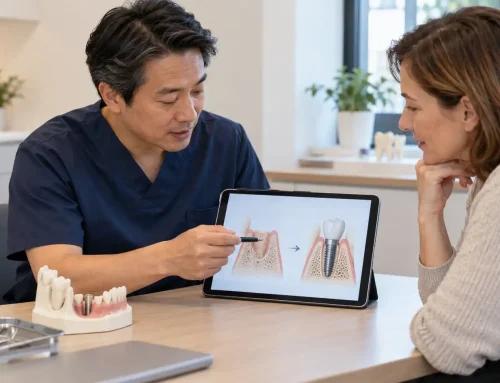
You may have seen an offer or a smile simulation. The assessment allows you to return to your real situation: what we know, what still needs to be checked and the possible solutions.
The plan begins with the future restoration
Before choosing the location of an implant, it is necessary to understand what tooth or prosthesis it will wear. The assessment looks at the available space, how the teeth meet and the maintenance conditions. A technically-placeable implant is not a complete prosthetic project in itself.
The examination of the gums looks for inflammation and periodontal disease to be managed. Neighboring teeth, possible infections and the quality of cleaning are part of this preparation. A stable mouth and a workable maintenance help to build a more coherent project.
Bone, anatomy and general health
Images are chosen to study the site. They can provide information about bone volume and the proximity of structures such as a nerve or sinus. A three-dimensional scan can be useful depending on the treatment plan; it should not be presented as a mandatory identical examination for all situations.
The practitioner should know your illnesses, smoking, possible diabetes and your medications. Some medicines that affect bone, a history of radiation therapy or a difficulty in healing require special attention. Bring an accurate list with the prescribed doses, without stopping or modifying a drug of your initiative.
Questions that support informed consent
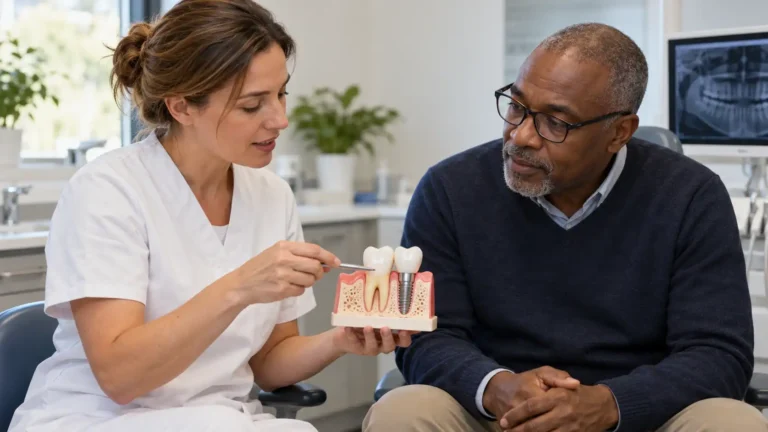
Ask why this solution is being proposed, what the alternatives would change, and what factors make the outcome less predictable. If a graft is considered, explain its reason and its place in the calendar. The assessment must also clarify the provisional solution, the assessments and the person to contact in case of problems.
Finally, check the organization: time available, travel, possibility to clean the prosthesis and cost of the whole course. A quote limited to surgery can be difficult to compare to a quote that includes the abutment and crown. You must be able to explain with your words the main steps and their limits before making a decision.
Gathering information for the implant assessment
The practitioner evaluates the tissues, the condition of the teeth and gums, as well as bone conditions. Periodontitis to be treated must be incorporated into the treatment plan. Complementary exams are chosen as needed, without turning each imaging into a mandatory step for everyone.
Can you go back to the assessments? Have you understood the maintenance actions and the conduct to keep in case of problems? The follow-up of an implant deserves to be discussed before, not only after the procedure.
Ask what makes the plan feasible, what could complicate it and which alternatives exist. If a bone graft is proposed, clarify its purpose and where it fits. Then request a quote distinguishing the procedures and any additional stages.
Frequently asked questions
Key takeaways
The assessment is not only used to say yes or no. It helps to understand the risks, steps and conditions of a realistic follow-up. The assessment checks the oral situation, the available bone, the tissues and the health elements that can change the treatment plan. The exams requested answer these questions; they should not be seen as a formality before treatment has already been decided. Present your medications and history, and then explain the alternatives, risks, and costs. Prior preparation or treatment may be necessary. Ask what needs to be improved before placement and how the decision will be re-evaluated.
 Numa Costa
The pen name under which I write articles and develop my editorial websites. Curious by nature, I like to understand how things work, explore everyday questions and make information easier to understand and use.
→ More about the author