Receding gums: what does gum recession mean?
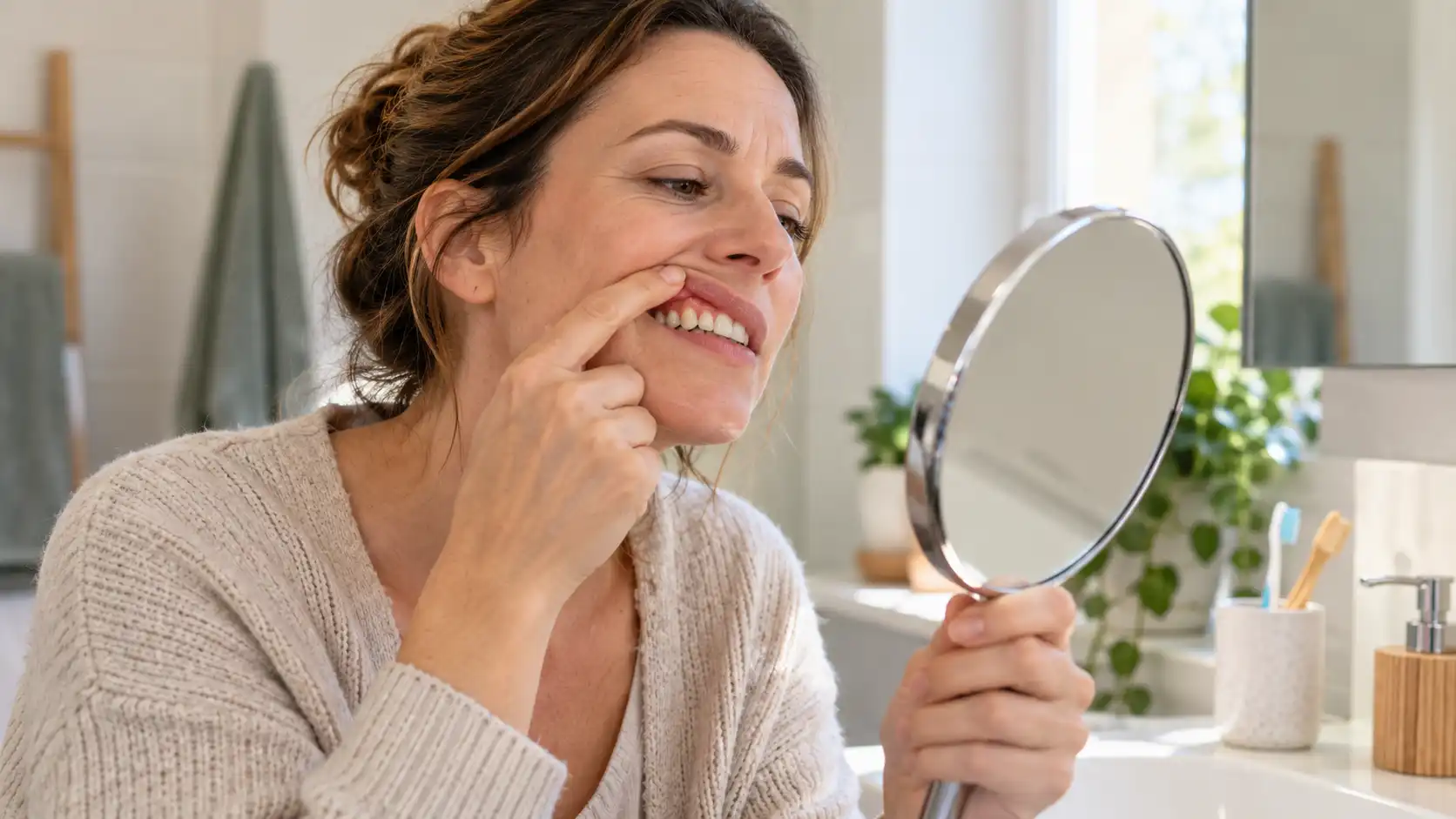
Receding gums expose more of a tooth’s root. The French term “déchaussement” is often used, but does not by itself establish the cause or the treatment needed.
Important
This article provides general information and does not replace an individual consultation, diagnosis or treatment from a dentist or another healthcare professional. If you have symptoms, seek advice appropriate to your situation. Do not change a treatment based solely on this content.
Avoid aggressive gestures and recipes that are supposed to regrow gums. A recession must be looked at, especially if it progresses or becomes sensitive.
A tooth suddenly seems longer in a photo. Is it recent or have you just noticed it today? This hesitation is frequent: the appointment serves precisely to establish a reliable starting point.
Why a root becomes visible
The gums can move and allow part of the root to appear. The root is not covered with enamel: its surface is covered by cementum, less protective than the enamel of the crown. A sensitivity to cold or contact can then appear, without the tooth necessarily being decayed.
The French term “déchaussement” is used for different situations. It may describe gum recession, but also loss of support associated with periodontitis. It helps to clarify what has changed: the gumline, the attachment around the tooth, the bone or several structures together.
Distinguishing possible causes
Aggressive brushing, fine gums, the position of some teeth, and periodontal disease can all contribute to the problem. The presence of a recession does not allow you to choose between these causes by looking only at a photo.
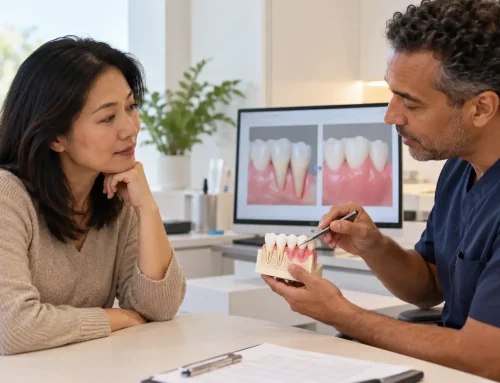
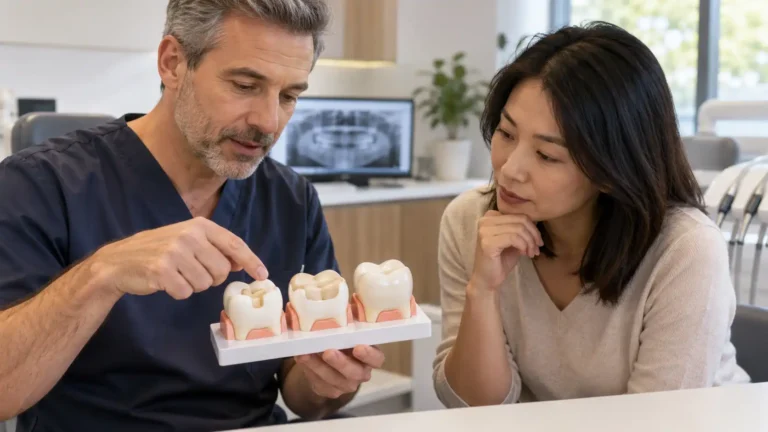
The assessment measures root exposure, looks for inflammation, and examines supporting tissues. Images may be needed depending on the context. The dentist also checks changes over time: a stable and comfortable zone does not necessarily require the same care as a recession that progresses and becomes painful.
Stabilising, protecting or covering
The first measures can be brushing technique, inflammation control and sensitivity. Local products or treatments can protect an exposed surface. They do not regrow the gum as if no tissue had been lost.
A graft may be considered in certain situations to improve the coverage or thickness of the tissues. Its interest depends on the anatomy, the expectations and the limits of the possible result. Ask which goal is a priority: reduce sensitivity, facilitate maintenance, limit an evolution or improve the appearance. While waiting for the assessment, keep the area clean with gentleness and avoid multiplying friction to try to remove a stain located on the root.
Monitoring an exposed root
Periodontal disease or traumatic brushing may occur. Other local peculiarities also come into play. An examination is necessary to separate these possibilities and verify the support of the tooth.
Explain what triggers discomfort and how long it has been around. The article on cold sensitivity helps to describe the symptom; it does not allow to deduce the cause. Also review your brushing technique.
The dentist may suggest an adaptation of the techniques, care or, in some indications, a gum graft. Ask for the concrete objective: limit progress, reduce sensitivity or cover an exposed area.
Frequently asked questions
Key takeaways
A visible root invites you to look for a cause and a goal of care. The assessment makes it possible to choose an appropriate answer. A more visible root may reflect gum recession, while the French term “déchaussement” can cover different situations. Assessment investigates the cause and checks the tooth’s support before discussing options. Correcting traumatic brushing can be part of prevention; a graft is not suitable for every case. Clarify whether treatment aims to stabilise the problem, protect a sensitive surface or cover part of the root, and what its limits are.
Sources
Cleveland Clinic — Gum Recession (2022).
NIDCR NIH — Oral Hygiene (date non affichée).
Last editorial review: October 2026
 Numa Costa
The pen name under which I write articles and develop my editorial websites. Curious by nature, I like to understand how things work, explore everyday questions and make information easier to understand and use.
→ More about the author