A loose adult tooth: what causes should be investigated?

A permanent tooth that becomes mobile must be examined. Tooth support and recent shock are some of the situations to look for.
Important
This article provides general information and does not replace an individual consultation, diagnosis or treatment from a dentist or another healthcare professional. If you have symptoms, seek advice appropriate to your situation. Do not change a treatment based solely on this content.
After a shock, a displaced or highly mobile tooth requires an urgent consultation. Do not try to put it back in place by manipulating it.
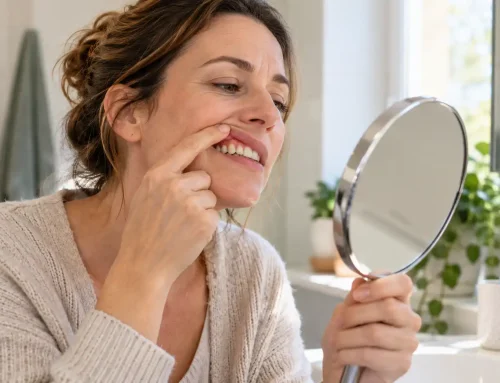
The reflex is often to test again and again with the tongue. However, seeing the problem once and explaining its context is more useful than multiplying the movements.
A loose tooth can have several causes
A tooth is held in place thanks to its root, the ligament that surrounds it and the supporting bone. Damage to these structures can alter its stability. Periodontal disease, shock or certain mechanical constraints are among the elements that the dentist is looking for.
The context changes the orientation: a mobility immediately appearing after an accident requires rapid care, while a mobility gradually noticed requires an assessment of supporting tissues. In both cases, the absence of pain does not allow to ignore the change.
What the dentist assesses
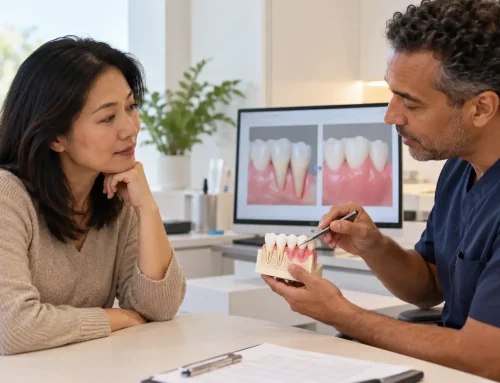
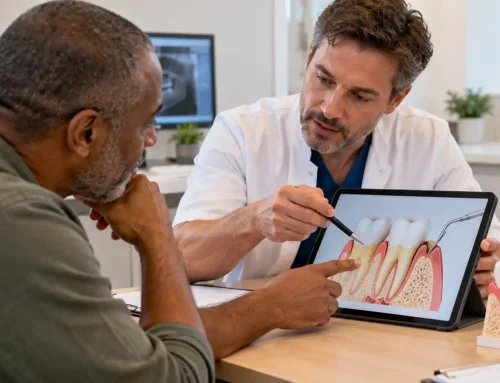
The exam appreciates mobility, chewing contacts, bleeding, pockets, and the condition of nearby teeth. Useful X-rays provide information on roots and bone support. A tooth that seems longer can be a recession; a tooth that is displaced after a shock is another situation.
The assessment then makes it possible to discuss the possibilities of conservation. The degree of mobility is one element, but not the only one: the cause, the amount of support and the ability to control the problem also matter. A mobile tooth is not automatically a tooth to be extracted.
Avoiding actions that complicate assessment
Do not move the tooth several times a day to compare. Avoid voluntarily biting hard food on it and do not improvise a splint. After a shock, do not try to reposition a tooth left in its socket; leave this manipulation to the professional.
On the phone, indicate if the mobility is recent, if there has been an accident and if you see a movement or bleeding. The treatment may focus on the inflammatory cause, constraints or trauma, with appropriate follow-up. If stabilization is proposed, ask for its goal and how to clean around it: keeping the tooth in place is not enough to deal with all the underlying problems.
Protecting a loose tooth while awaiting care
Did mobility appear after a fall, gradually or during a meal? Also note the bleeding and pain. The dentist will examine the support of the tooth and the circumstances of the change.
Periodontitis can reduce this support. But the word “mobile” does not allow to conclude remotely that the tooth is lost or that an extraction will be necessary.
For shock-free mobility, contact a practice quickly and describe the symptom. In case of a tooth coming out of its location, the marks of the article on the knocked-out tooth concern another emergency, with specific gestures.
Frequently asked questions
Key takeaways
The context counts: progressive mobility and a tooth displaced after a shock require different assessments. A mobile adult tooth should be examined rather than tested regularly with fingers or tongue. Possible causes include periodontal support, trauma or certain constraints; treatment depends on what is found. Indicate when mobility exists, whether it is increasing, and whether it is accompanied by pain or bleeding. After a shock, quickly ask for an orientation. Even if the discomfort remains low, the assessment helps decide what can be stabilized and how to follow it.
Sources
NIDCR NIH — Periodontal Gum Disease (date non relevée).
Assurance Maladie — Traumatisme dentaire dent contuse fêlée cassée ou luxée (2025).
Last editorial review: October 2026
 Numa Costa
The pen name under which I write articles and develop my editorial websites. Curious by nature, I like to understand how things work, explore everyday questions and make information easier to understand and use.
→ More about the author