Dental bone grafting: why might it be recommended?
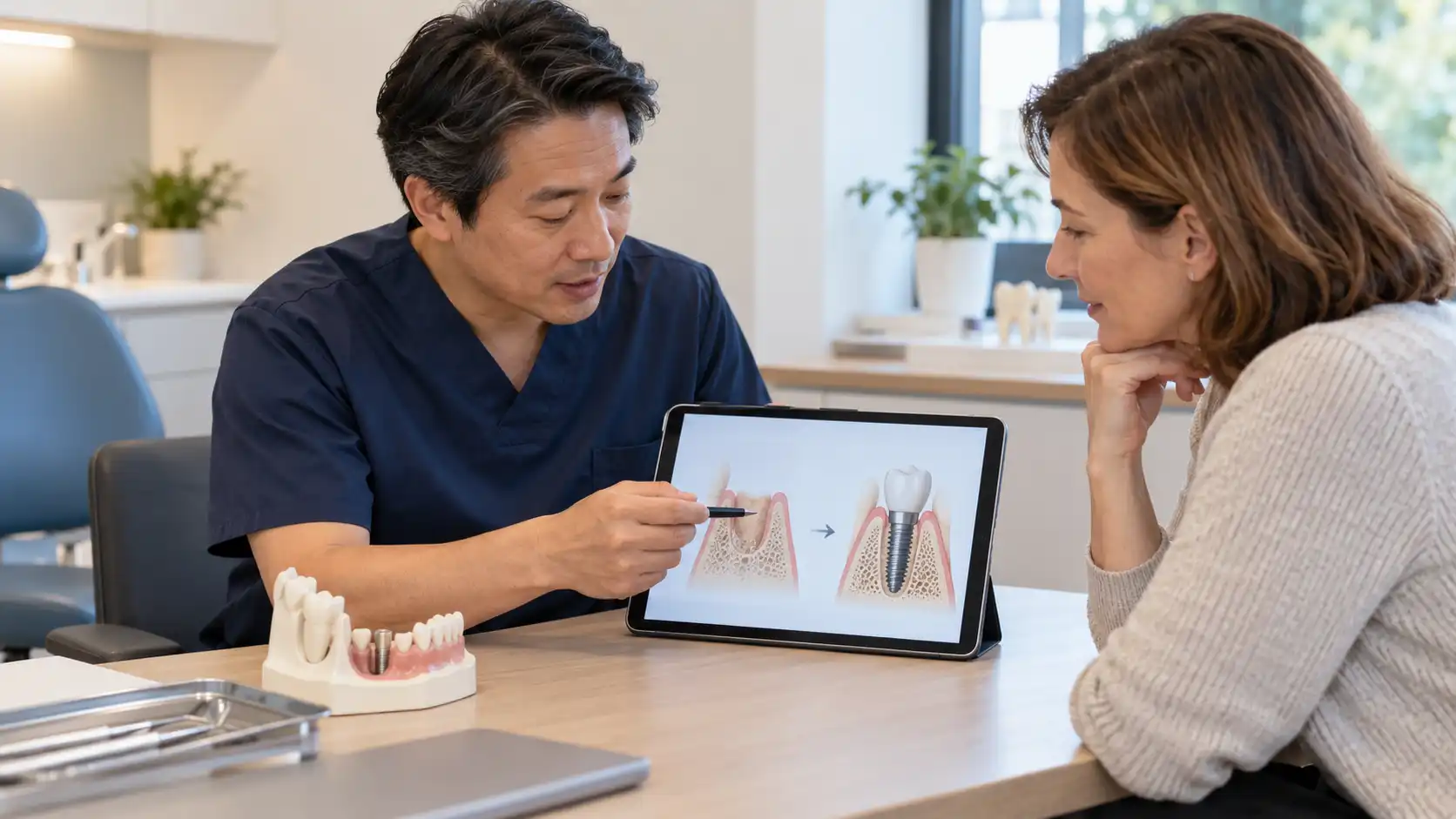
A bone graft may be proposed when bone conditions are not suitable for the treatment project. Its goal is to improve the support available.
Important
This article provides general information and does not replace an individual consultation, diagnosis or treatment from a dentist or another healthcare professional. If you have symptoms, seek advice appropriate to your situation. Do not change a treatment based solely on this content.
A graft is neither systematic nor a guarantee of implant success. The assessment must specify the expected benefits, risks and alternatives.
Discovering an additional step can change your organization and your budget. It is reasonable to ask why it is necessary in your case before discussing the schedule.
Why the available bone may be insufficient
The implant treatment plan requires a bone volume compatible with the intended location and nearby anatomical structures. After the loss of a tooth or certain diseases, the shape of the area may not allow the desired assembly. The assessment is used to describe this lack precisely, rather than to describe the entire jaw as “bad”.
A graft aims to improve the conditions of the site. It may be limited to one area or require a larger intervention. The essential question is what it makes possible and what alternatives exist if we do not want this additional gesture.
How graft material supports reconstruction
Depending on the situation, the practitioner uses bone taken from you, a material of human or animal origin, or a synthetic substitute. The material can help maintain volume and provide an environment for bone formation. Its origin alone cannot predict the outcome.
A membrane can be combined with the material to protect the area during healing. The techniques and constraints differ depending on the site. An increase near a sinus, for example, does not have exactly the same course as a small complement around an implant.
Grafting with or before implant placement
Some grafts can be performed during the installation; others require a separate phase and a check before continuing. This distinction changes the number of interventions, the interim solution and the organization of treatment.
Ask what signs will judge that the site is ready and what would happen if the reconstruction was insufficient. Risks, maintenance instructions and costs must be presented prior to consent. No graft alone guarantees the success of the implant. Smoking, medical condition, inflammation and adherence to instructions should also be taken into account in the follow-up.
Understanding where grafting fits in the schedule
The question is not just “Do I have enough bone?” but “Enough bone for which treatment, and where?” The implant assessment relates these findings to the proposed plan.
The materials may have different origins. Ask which one will be used, why it is retained and what it means for you. The discussion of grafting materials helps to prepare this question without arbitrarily classifying the options.
Ask if the graft and implant placement are planned together or separately, and how healing will be controlled. Do not organize a trip or an important event for a supposedly identical duration for all.
Frequently asked questions
Key takeaways
The graft is a response to a specific need of the treatment plan. Its indication and limits must be explained before the intervention. A bone graft may be considered when the volume or configuration of the bone is not suitable for the planned treatment. It is not automatically part of any implant treatment. Ask why it is offered, what other options exist, what material will be used and how healing will be followed. The graft adds steps, costs and risks to discuss. It alone does not guarantee the future success of the implant: the assessment and monitoring remain decisive.
 Numa Costa
The pen name under which I write articles and develop my editorial websites. Curious by nature, I like to understand how things work, explore everyday questions and make information easier to understand and use.
→ More about the author