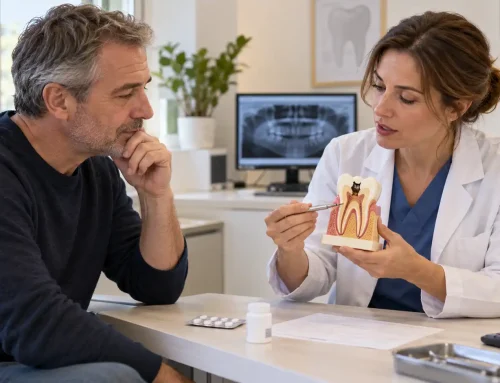
Root canal treatment: what does it treat?
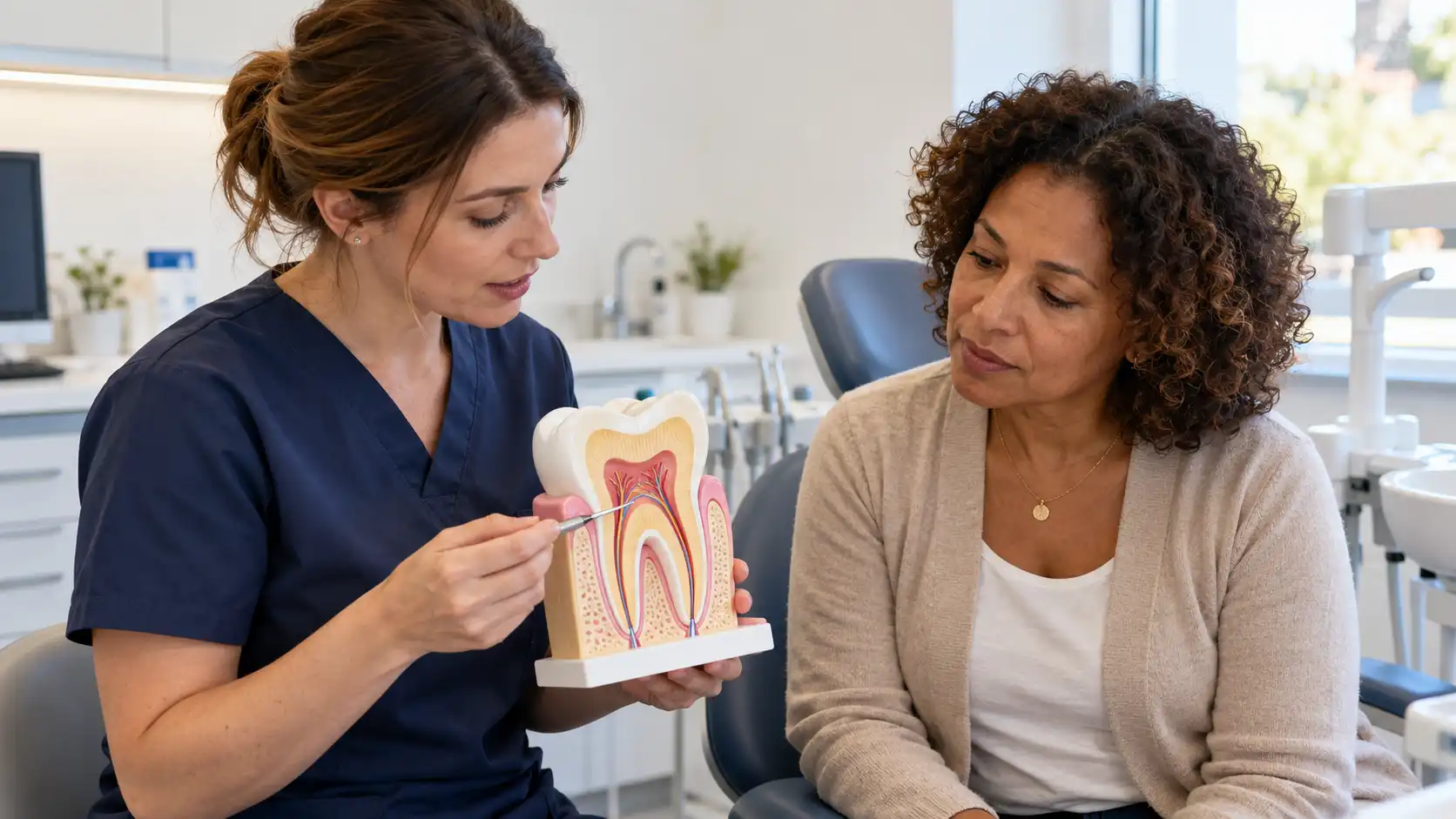
Root canal treatment, called “dévitalisation” in French, removes affected pulp tissue, cleans the inside of the tooth and seals the canals. Its aim is to preserve a tooth that can still be restored rather than extract it.
Important
This article provides general information and does not replace an individual consultation, diagnosis or treatment from a dentist or another healthcare professional. If you have symptoms, seek advice appropriate to your situation. Do not change a treatment based solely on this content.
The decision depends on the diagnosis and the condition of the tooth. Pain alone does not tell whether this care is necessary.
The French term “dévitaliser” may suggest that the whole tooth is removed. In fact, treatment concerns its interior, while the remaining tooth then needs protection.
The pulp, root canals and surrounding tissues
The pulp occupies the central part of the tooth and extends into the root canals. It contains vessels and nerves. A deep cavity or some trauma can damage it; an endodontic treatment then aims to treat this space to retain the tooth when possible.
The root is not removed during this treatment. It remains in the bone, surrounded by tissues that continue to react to pressure and possible inflammation. A root canal-treated tooth does not therefore become a structure unrelated to the rest of the mouth.
The stages of root canal treatment
After assessment and appropriate anaesthesia, the dentist gains access to the inside of the tooth. A rubber dam isolates it from saliva and limits contamination during treatment. The root canals are located, cleaned, shaped and disinfected, then filled and sealed.
A tooth can have several root canals, sometimes difficult to reach. Depending on the situation, one or more sessions are required. Between appointments, a temporary closure protects the tooth; it should not be considered as a permanent restoration. Report its loss or a fracture.
Why the final restoration matters
After the inner treatment, it is necessary to restore a durable closure and a form for chewing. The amount of remaining tooth, its position and the forces it receives guide the choice of a restoration: a filling, an onlay or a crown can be discussed depending on the case.
Without this step, a weakened tooth can fracture or allow bacteria to penetrate again. So ask for a plan that distinguishes between root canal treatment, restoration, and check-ups. Transient discomfort may occur after treatment, but pain that increases, swelling or difficulty chewing require contacting the office. Monitoring is also used to check changes in the tissues around the roots.
Planning the restoration after root canal treatment
The pulp contains nerves and vessels. When it is affected, endodontic treatment may be indicated. The tooth remains in place; it is not an extraction.
The cleaning of the canals and the visible restoration meet two different needs. A crown can be proposed depending on the amount of tooth structure remaining. Ask for the full plan, not just the first session.
The number of appointments varies depending on the situation. Specify the possible presence of a temporary filling, the precautions between sessions and the contact to be used if the pain worsens.
Frequently asked questions
Key takeaways
The canals and the final restoration are two complementary steps. Ask how the tooth will be treated and protected. The treatment of the canals is aimed at the inside of the tooth in order to keep it when possible. The cleaning and filling of the canals do not meet the same need as the visible reconstruction: the final restoration must also ensure the protection of the tooth. Ask for the number of steps, the instructions between sessions and the type of restoration planned. An improvement after the first appointment does not mean that the treatment is over or that the assessments can be abandoned.
 Numa Costa
The pen name under which I write articles and develop my editorial websites. Curious by nature, I like to understand how things work, explore everyday questions and make information easier to understand and use.
→ More about the author