A tooth sensitive to cold: when to see a dentist

Sensitivity to cold can have several causes, including caries or an exposed root. If it comes back, extends or touches a specific tooth, an examination makes it possible to understand the origin and choose the care.
Important
This article provides general information and does not replace an individual consultation, diagnosis or treatment from a dentist or another healthcare professional. If you have symptoms, seek advice appropriate to your situation. Do not change a treatment based solely on this content.
Severe pain, swelling or fever should not be attributed to mere sensitivity.
The cold can cause a brief discomfort or leave a pain that lasts. For the appointment, this difference is more useful than the single word “sensitive”.
Why cold can trigger sensitivity
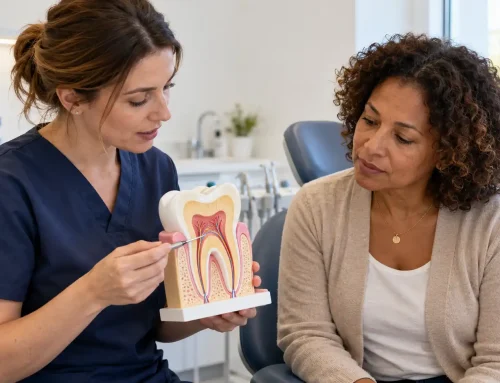
Beneath the enamel is the dentin, traversed by tiny channels connected to the inside of the tooth. When it becomes more exposed, for example at an exposed root, changes in temperature can cause a brief sensation. Tooth decay, a crack or a faulty restoration can also cause a tooth to react.
Brief discomfort that stops quickly after contact with cold is different from pain that persists afterwards, wakes you at night or occurs on its own. Describing this distinction helps guide the dentist’s assessment. It cannot establish the cause by itself.
What the assessment aims to distinguish
The examination looks at the gums, worn surfaces, restorations and the possible presence of a lesion. Comparative tests and an X-ray may be required depending on the tooth. If several areas are sensitive, eating habits, brushing and dry mouth can also be discussed.
Treatment follows the cause: a less aggressive brushing technique, a desensitizing product, local protection or tooth care may be considered. A toothpaste for sensitive teeth can help in some cases, but its use should not be used to indefinitely postpone the examination of a tooth that changes.
Describing pain in a useful way
Prepare four benchmarks: location, trigger, duration and evolution. For example: “A tooth at the bottom left has been reacting to cold drinks for a week; the sensation stops when I put down the glass.” It is not necessary to be sure of the tooth number.
While waiting for the appointment, avoid voluntarily repeating the stimulus to check. Continue gentle cleaning and quickly report growing pain, swelling, or discomfort with chewing. Difficulty swallowing or breathing is a medical emergency. Temporary relief helps with comfort; it does not confirm the diagnosis.
Explaining your reaction to cold
Note the tooth or area, trigger, duration, and newness of the problem. Avoid constantly testing with very cold water: just tell the ordinary episodes.
Tooth decay and gum recession are different problems. An examination distinguishes them and other possible causes. A photograph or a product chosen at random cannot replace it.
Ask whether the proposed measures address the cause or only the discomfort. If a specific toothpaste is recommended, clarify the follow-up and the signs that should prompt another call to the practice.
Also report whether you are thinking of clenching or grinding your teeth; this observation will be evaluated without automatically concluding a cause.
Frequently asked questions
Key takeaways
Observe the trigger and duration, then have repeated sensitivity examined. Treatment depends on the cause. To describe a sensitivity, note the tooth or area involved, what triggers it, and how long the sensation persists. This information helps to distinguish several possible causes, without allowing a remote diagnosis. A product for sensitive teeth may have a place after advice, but an improvement does not prove that everything is settled. If the episodes repeat or change, have the tooth examined; severe pain, swelling or fever require prompt professional advice.
 Numa Costa
The pen name under which I write articles and develop my editorial websites. Curious by nature, I like to understand how things work, explore everyday questions and make information easier to understand and use.
→ More about the author