Tooth decay in baby teeth: why does it need treatment?

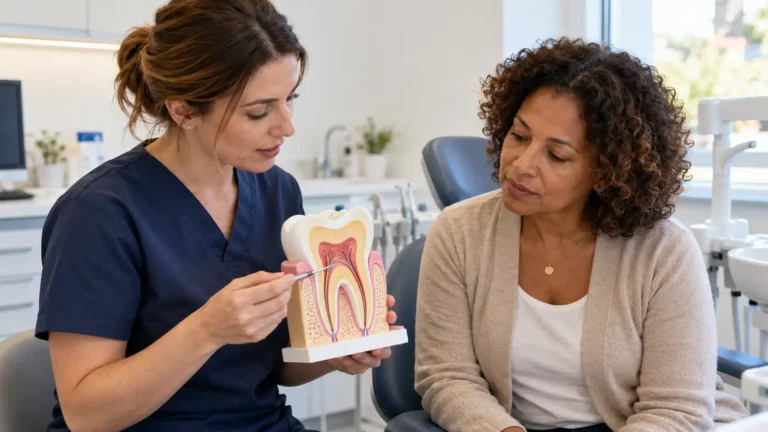
A cavity of a baby tooth should be evaluated. The fact that the tooth is temporary does not eliminate the risk of pain, infection or difficulties on a daily basis.
Important
This article provides general information and does not replace an individual consultation, diagnosis or treatment from a dentist or another healthcare professional. If you have symptoms, seek advice appropriate to your situation. Do not change a treatment based solely on this content.
A swelling, a fever or a child who eats or drinks with difficulty justify a quick contact with a professional. Do not choose an adult treatment alone.
“It will fall” seems reassuring. But this answer does not say when the tooth will fall or what may happen before. An examination makes it possible to offer care adapted to his condition and to the child.
Baby teeth have an important role now
Milk teeth are used to eat, talk and maintain the conditions of the child’s teeth. Their future replacement does not remove these functions during the years they remain in the mouth. A cavity can cause pain, infection, or difficulty feeding before natural fall.
The time remaining before replacement varies depending on the tooth and stage of development. It is therefore not enough to know that it is a baby tooth to conclude that a care would be useless. The dentist takes into account the lesion, the symptoms and the place of this tooth in the evolution of the mouth.
Treatment does not always mean extraction
Depending on the stage, treatment may be aimed at controlling an early lesion, restoring the tooth or managing a deeper involvement. Extraction may be necessary in some situations, but is not the automatic response to any decay.
The plan must be adapted to the child’s ability to receive care. Ask what will be achieved, how comfort will be ensured and how many appointments are planned. Avoid promising in advance that there will be “nothing at all”: a simple and faithful explanation to the appointment is more useful than an uncertain promise.
Preventing new decay after treatment
The restoration treats the affected tooth without removing the factors that favor other cavities. Follow-up should also address accompanied brushing, suitable toothpaste and repeated sugary intakes. Describe the habits without trying to hide a difficulty: the advice will be able to better take into account the daily life.
Nocturnal pain, swelling, or difficulty eating require quick contact. An absence of pain does not allow to systematically wait for the fall of the tooth. After the treatment, ask what will be monitored and what actions will be taken at home. The goal is to maintain the comfort and functions of the mouth during growth.
Preparing for care of a baby tooth
A coloring is not a diagnosis, and a caries can be little painful. The dentist assesses the lesion and the possibilities of care.
Avoid promises like “you’ll feel absolutely nothing.” You can say that the professional will look at the tooth and explain how to help it. Report fears and difficult experiences before the session.
Accompanying brushing and eating habits are part of the suite. Ask what needs to be changed concretely, rather than a global judgment on family food.
Frequently asked questions
Key takeaways
A baby tooth has a role while it is present. Its temporary nature does not exempt the evaluation and treatment of caries. A baby tooth allows you to eat and participates in daily life as long as it is present. A cavity can therefore have consequences before it falls out naturally and deserves an assessment. The care depends on the condition of the tooth, the symptoms and the situation of the child; its temporary nature is not enough to decide to wait. Prepare the consultation with simple words. Swelling, fever or difficulty drinking and eating should be reported promptly.
Sources
Assurance Maladie — Traitement des caries (2025).
NIDCR NIH — Tooth Decay (date non affichée).
Last editorial review: October 2026
 Numa Costa
The pen name under which I write articles and develop my editorial websites. Curious by nature, I like to understand how things work, explore everyday questions and make information easier to understand and use.
→ More about the author