Early tooth decay: can you stop it before a cavity forms?

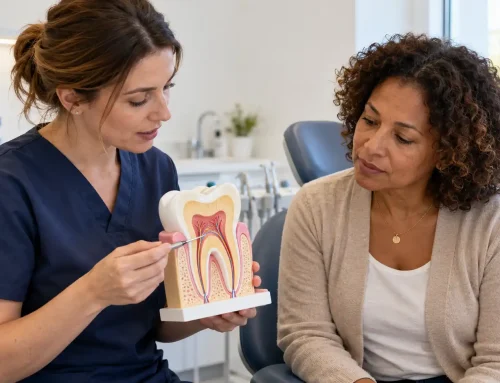
A very early tooth decay lesion, before the formation of a cavity, can sometimes be stopped or remineralized. When a hole is formed, the tooth does not rebuild spontaneously. The dentist determines the stage and care required.
Important
This article provides general information and does not replace an individual consultation, diagnosis or treatment from a dentist or another healthcare professional. If you have symptoms, seek advice appropriate to your situation. Do not change a treatment based solely on this content.
A visible spot does not alone diagnose a cavity. Have any persistent changes examined.
The word “early” can be reassuring, but it does not tell on its own what is happening in the tooth. The useful question is: is the surface still intact and is the lesion active?
What can still be remineralised
A cavity begins with a loss of minerals due to acids produced by bacteria. At the initial stage, the surface of the enamel can remain intact while its structure is weakened. A white spot can correspond to this phenomenon, but also to other modifications of the enamel: its appearance is not enough to make the diagnosis.
When the lesion is not cavitary, the dentist can propose a prevention program to promote its stabilization. This combines plaque control, adapted fluoride and a reduction in repeated sugar exposures. Local protection or treatment can be discussed depending on the tooth and the affected area.
When a restoration becomes necessary
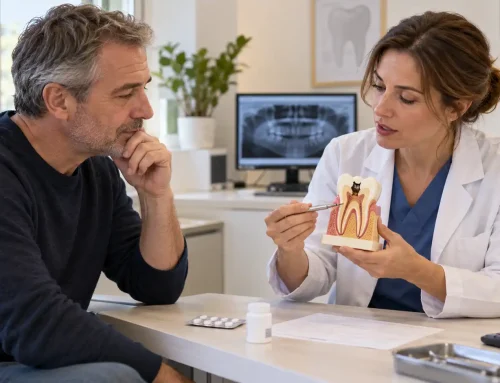
If the surface has collapsed and a hole has formed, it really lacks dental tissue. Brushing cannot rebuild this part. Care then aims to treat the lesion and restore the shape of the tooth with an appropriate material, keeping as much healthy tissue as possible.
The depth, accessibility and proximity of the pulp change the options. Two lesions of apparently similar size may therefore be part of different strategies. A cavity between two teeth may be less visible than a cavity on a chewing surface, without being less important.
Monitoring needs a purpose
Monitoring a lesion means following a plan: improving risk factors, defining a check-up and comparing observations. It’s not just waiting for it to become painful. Ask what elements will allow you to judge that it is stable and what would change the support.
To prepare this follow-up, bring your toothpaste and describe the habits of drinks or snacks. Report dry mouth and hard to clean areas. The goal is not to find a single fault, but to act on the factors that sustain the injury. New pain, fracture or discomfort with chewing should be reported before the scheduled check-up.
Following an early lesion over time
Acid attacks cause the enamel to lose minerals. Saliva and fluorideide contribute to its protection. At an early stage, acting on risk factors can change the course.
A cavity can be painless. Control is used to examine what cannot be appreciated in the mirror. An X-ray can be offered as needed, without being systematic.
Ask what will be monitored, which techniques to change and when to check the result. If restoration is indicated, explain why prevention alone is no longer sufficient in this area.
Frequently asked questions
Key takeaways
The possibility of stopping a lesion depends on its stage. Early monitoring makes it possible to choose between reinforced prevention and repair. An early lesion without a cavity and an established hole are not managed in the same way. The dentist assesses the stage, activity and risk factors before recommending enhanced prevention or restoration. A visible spot is not enough to decide for yourself. Ask what will be monitored and how progress will be checked. Changing habits and using suitable toothpaste support prevention, but cannot replace repair of a cavity when this is needed.
Sources
NIDCR NIH — Tooth Decay (date non affichée).
Assurance Maladie — Traitement des caries (2025).
Last editorial review: October 2026
 Numa Costa
The pen name under which I write articles and develop my editorial websites. Curious by nature, I like to understand how things work, explore everyday questions and make information easier to understand and use.
→ More about the author